On January 24, 2026, China simultaneously imposed disciplinary measures and launched investigations into senior figures within the Central Military Commission (CMC), including CMC Vice Chairman Zhang Youxia, sending shockwaves around the world.
This is a political upheaval powerful enough to shake the structure of military authority and will bring far-reaching consequences for China’s political system.
According to international observers, this is a serious warning signal about internal instability within China’s military apparatus—especially as Beijing announced the decision on the eve of strategic personnel adjustments.
Under the rules, China’s Central Military Commission must have seven members, yet within just a few years, under Xi Jinping’s “iron hand,” a series of key figures have fallen one after another, leaving an almost hollowed-out structure.
With only Xi Jinping and Zhang Shengming remaining in the CMC, the stability of China’s Central Military Commission is becoming increasingly fragile.
The disciplining of senior generals through decisions that carry a strongly personal character means anyone under suspicion can be removed immediately, creating a political environment built more on fear than on political principles.
When there is no sufficiently strong mechanism of checks and balances, and no force capable of counterbalancing power, no general can feel safe—regardless of rank or level of loyalty.
A prolonged wave of purges in China’s military has fostered a constant sense of insecurity. When an army operates under fear, it may appear disciplined and powerful on the surface, but inside it is marked by spiritual decay and an erosion of trust.
The downfall of Zhang Youxia reflects a rupture in China’s military leadership structure and signals a protracted period of instability, in which purges may continue with no way out.
Chinese history once witnessed the “Tianjing Incident” of 1856 during the Taiping Heavenly Kingdom, when the leadership at the time destroyed one another from within before collapsing completely. China today may not have reached that ending, but internal weakening is a certainty.
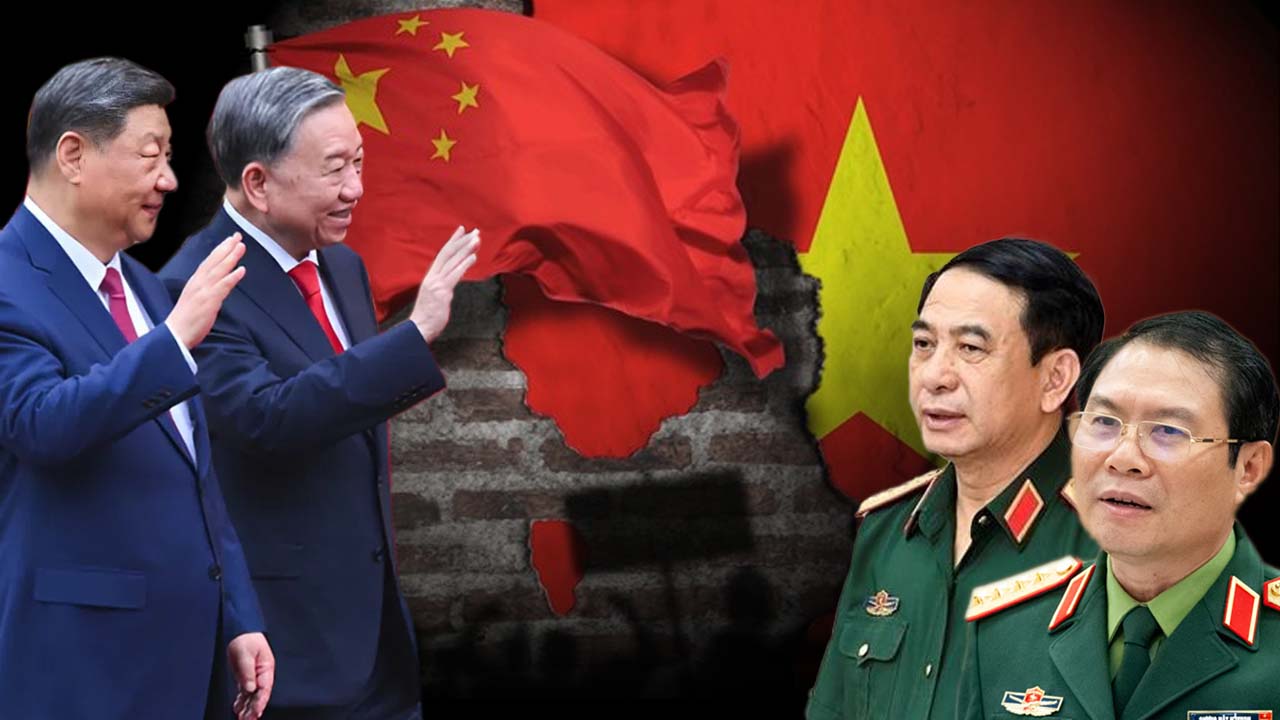
Meanwhile, developments in Vietnam after the 14th Party Congress, according to international observers, suggest that under the leadership of General Secretary Tô Lâm, Vietnam is becoming increasingly dependent on China’s political orbit—both in its model of centralized power and in the way the apparatus operates.
At the 14th Party Congress, General Phan Văn Giang did not secure a place in the “Five Pillars” group and only continued as Minister of National Defense, while Chief of the General Staff Nguyễn Tân Cương also did not obtain a seat in the Politburo. This shows that the political role of the military faction is being significantly narrowed by Tô Lâm.
As in Beijing, this is not a random phenomenon but the inevitable outcome of a highly centralized power model. When all political power is concentrated in the hands of one individual or one faction, then even the military faction, sooner or later, will be “cleaned up” to remove any counterweight.
If Vietnam’s political system is truly operating as a miniature copy of China’s, then the scenario of the military faction being further “cleaned up” and weakened is only a matter of time.
The lesson from China points to a dangerous paradox for Vietnam’s national defense strength. The more power is concentrated, the more solid the system appears on the outside—yet the more fragile military strength becomes than ever.
Viewed through the handling of China’s CMC leadership, this is a warning about the risks of an absolute power structure controlled by a single individual and faction—one that is beginning to take shape in Vietnam.
Trà My – Thoibao.de